Organic Landscape Design Xeriscape Experts Serving North Dallas Neighborhoods
0 Comments

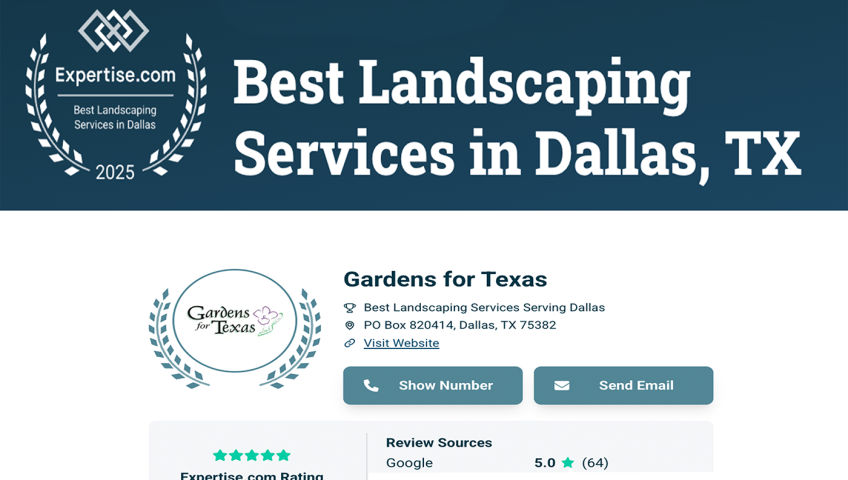
Expertise.com Top Rated 2025

We are honored to be listed as Top Rated on this roster of Dallas landscaping firms. THREE YEARS IN A ROW!

Each year firms are researched and rated based on LICENSING, USER REVIEWS AND MYSTERY SHOPPING CALLS.

Gardens for Texas has consistently been included in the 20 top firms in the Dallas area.

Our expertise, reliability, and client satisfaction are reflected in this testimonial.

https://www.expertise.com/home-improvement/landscaping/texas/dallas#gardensfortexas


EXPERTISE. COM Recommended Top 20

We did the research for you!

Our goal is to connect people with the best local professionals. We scored Dallas landscaping services on more than 25 variables across five categories, and analyzed the results to give you a hand-picked list of the best.

319 Reviewed | 199 Curated | 20 Top Picks

Learn about the selection process

0 Comments

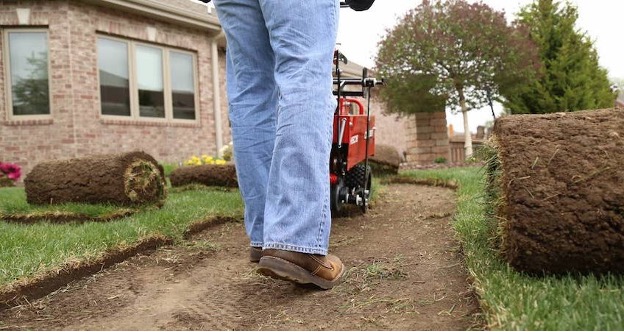
Turf Removal and Water Savings

Water-Thirsty Lawns

A lawn is the pride and joy of any homeowner who often makes it the focal part of their curb appeal. Grass requires a lot of water to remain lush and healthy. Day to day, people around the country run sprinklers or use watering cans, and even though the lawn looks nice, could water be saved by making some changes?  If you are evaluating water consumption and expenditure reduction, here are a few things to consider: 

Spray Head Irrigation System

In contrast to other plants, turf needs more water to keep it green, and the irrigation system is the usual way of delivery of this precious liquid. Typically, a system uses pop up spray heads that send water up into the air, expecting it to fall onto the ground and hopefully soak into the soil so the roots can take it up. This system wastes a lot of water due to evaporation.

Calculate Your Water Use

To calculate how much water you are using put a bucket to catch the water at one sprinkler head. An average sprinkler head uses four gallons per minute (GPM) or more. Once you know how many GPM each head is using, you can calculate how much water you are using based on how long you are running each head.

For example: If you have a zone (this is an area on your irrigation system that is controlled by one valve) that has 10 heads on it and each head is putting out four gallons per minute, you have 40 gallons of water coming out per minute for that zone. If you run that zone for eight minutes, that is 320 gallons of water that is being used to water just that one section of lawn.

Turf Alternatives

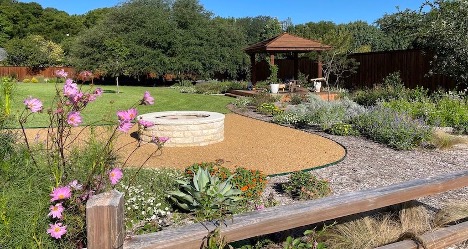
If you still want to gaze at a field of green, you can always turn to artificial turf. Not your look? you can use stones as part of your landscaping. You can cut down the size of the lawn so that it becomes the path you walk on through the garden. This is appealing for those who don’t want to get rid of their lawns entirely, but still want to reduce the amount of water used to maintain it.

Permeable hardscape and mulch include intervening walkways and seating areas where water can penetrate. Hence, bricks and flagstone can be set in sand. Gravel and decomposed granite are other examples. These elements really help to make the design more attractive.

Install Drought-Tolerant Plants

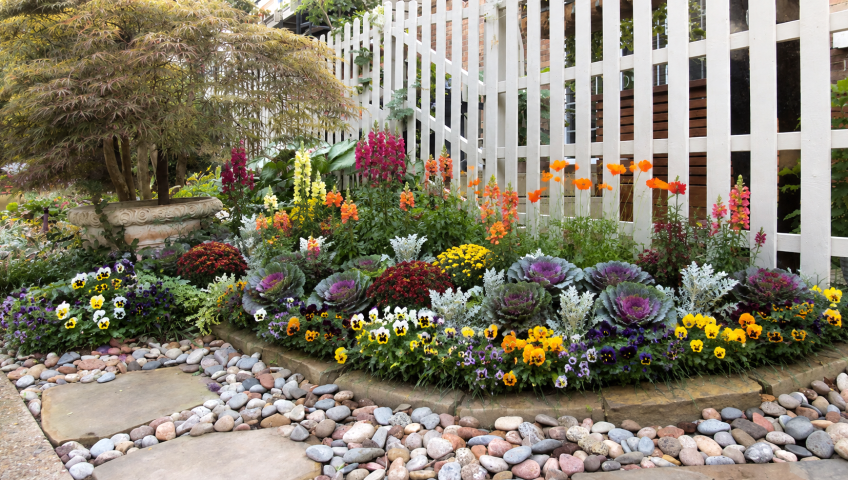
Using drought tolerant and native plants will significantly decrease your water use.

You might find that you are using fertilizers, pesticides and herbicides to maintain your lawn. Frequent watering may increase the need to weed.  Over time, this should decrease as you convert to water-friendly practices.

Water Saving Techniques

A great way to decrease water use is to schedule all watering for early morning or at dusk when there is less evaporation from the warmer hours of the day.

Significant water savings can be achieved by watering by hand or changing your irrigation system to a drip system The drip irrigation system will get water where the plants need it, so less chance of water wasted by above-ground spray head evaporation. Most drip emitters use one to two gallons per hour. The drip system will require regular checking as heads can get clogged or pop off. 
0 Comments

Community Impact | Gardens for Texas Interview

Gardens for Texas owners, Jamie Klingenberg and Sandra Hutchens, were interviewed by Community Impact for their “Ask a Landscaper” series. It was published in the Lake Highlands/Lakewood edition.

View Article

What are your top tips as a landscape designer to keep your yard looking nice and healthy in the heat?

First of all, plan early. For the peak spring season, it is wise to start planning during the winter. Then get on the installation schedule before the summer heat occurs. This strategy will allow time for new plants to get established before the stress of heavy heat. If unavoidable, a new landscape installation during summer months needs more frequent watering, then tapering off as the weather cools. New turf needs daily watering when it is very hot. Projects can often be completed in phases. During the heavy heat season, hard-scape components can be installed followed by plants once the cooler weather arrives.

What is the best time of day in the summer to get landscaping tasks done?

For homeowners, before 10 a.m. and after 4 p.m. Watering at this time of day is important since it decreases the amount of evaporation loss and hydrates plants for a longer period.

What are homeowners’ biggest mistakes when self-landscaping?

Starting a project without a cohesive plan. [There is] temptation to purchase a selection of plants at the nursery that may not be the best choice for the Dallas area or the homeowner’s property conditions, [due to it being] too sunny, too shady, etc.

What are the most popular landscape design trends in Dallas?

Xeriscaping has become increasingly popular as homeowners seek to update their landscape style and water use. Many of our clients are seeking a modern, sleek style that is low maintenance. We specialize in using Texas native plants that are not only beautiful but are adapted to Dallas weather conditions. Breaking up a large space of turf into multiple spaces can make the landscape more conducive to outdoor living. This includes removing turf, expanding beds, creating pathways and seating areas, [and] using stone and mulch to reduce water use and create visual appeal.

Is there anything homeowners should do for their project before hiring a landscape designer?

Research ideas, desired style and major components. Have a budget in mind. Provide a plot plan. Be aware of special conditions to inform the designer, [such as] drainage, heavy shade, plant disease issues, utility and irrigation locations, [and the] presence of pets to avoid installing toxic plants.